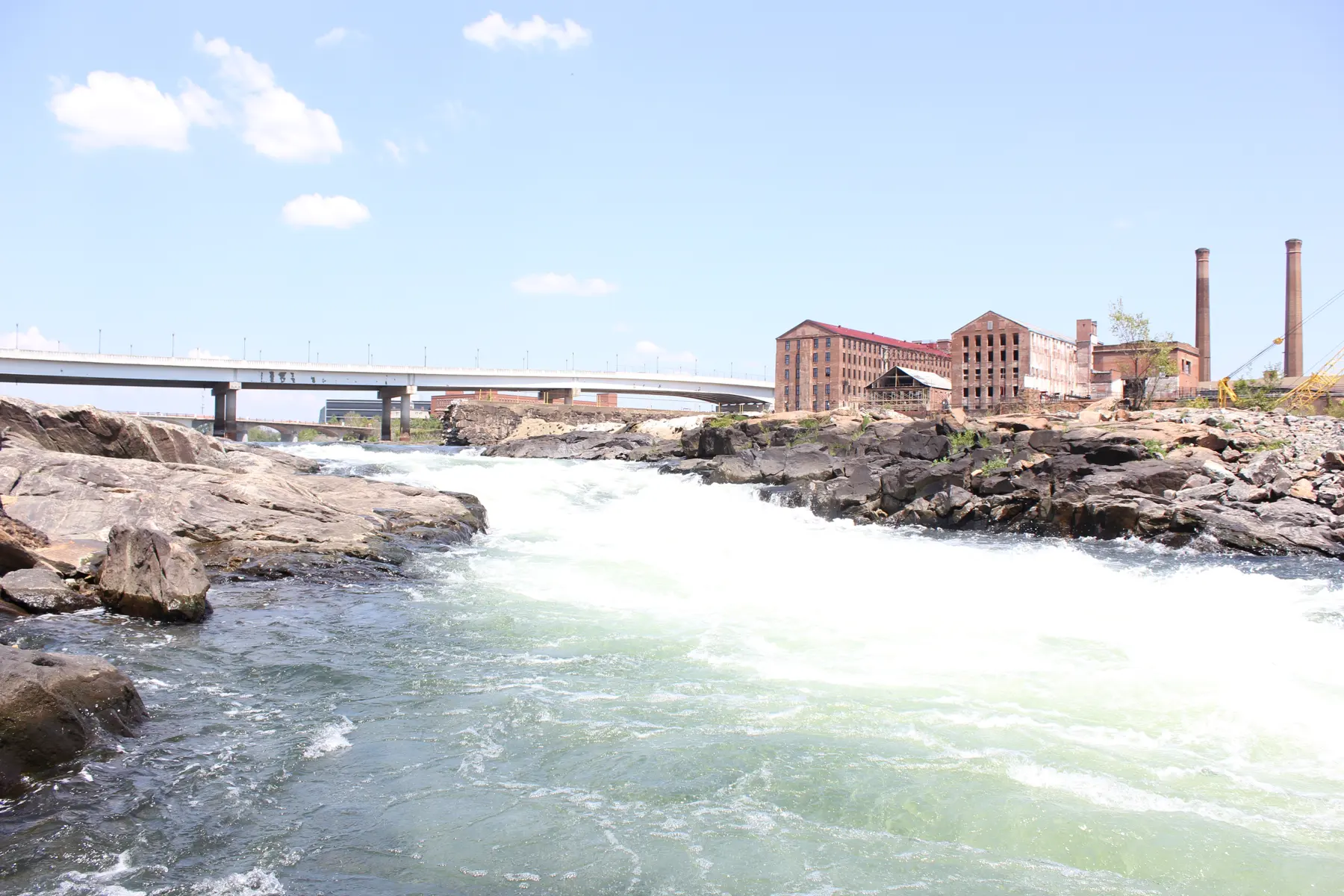
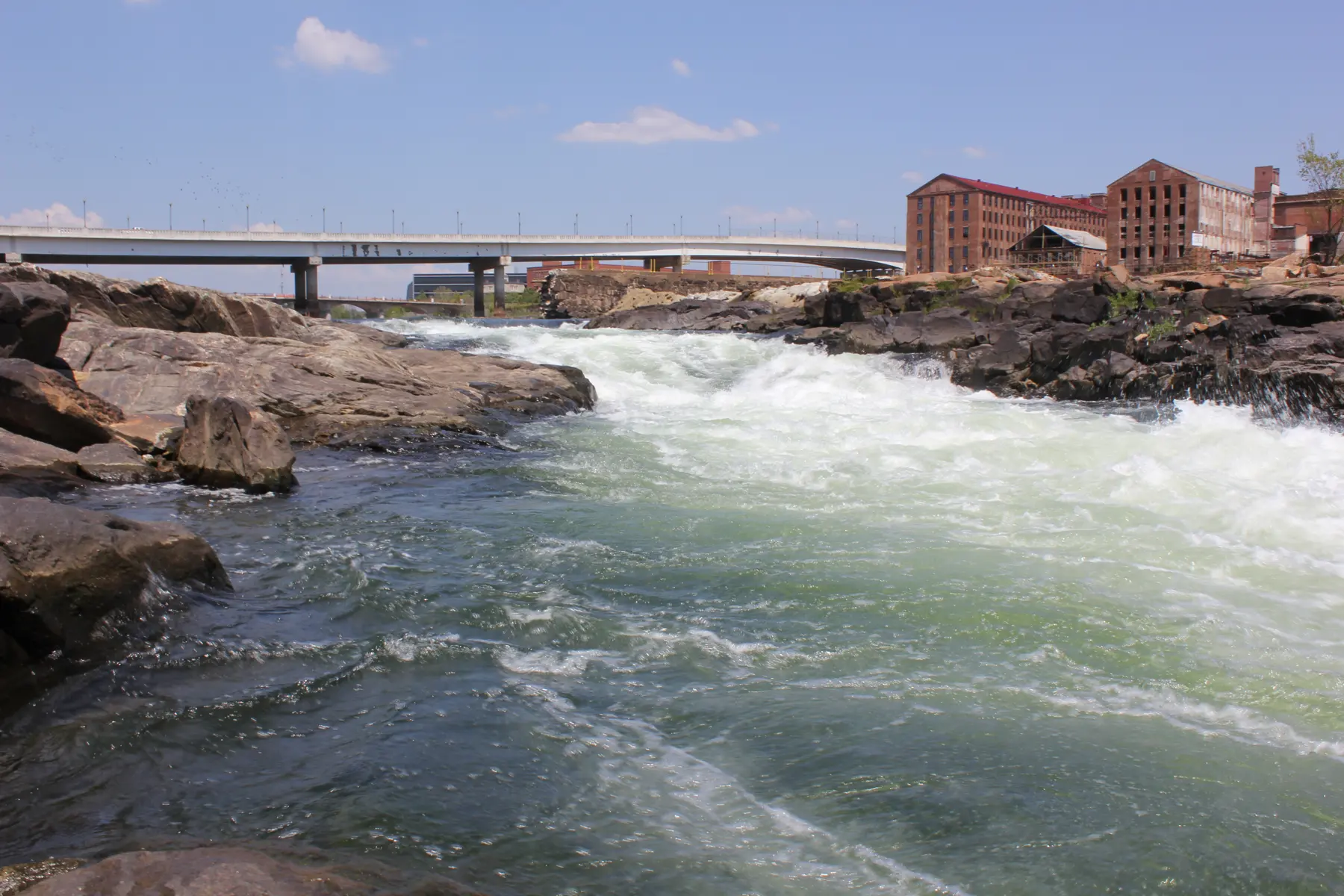
Tap any rapid to see what it is, where it is and how it changes when the dam opens up. Switch between low water and high water to watch the river transform.
Photo: WhitewaterColumbus.com, August 2012.
Quick answer
The Columbus whitewater course runs about 2.5 miles down the Chattahoochee from just below North Highlands Dam to Uptown Columbus. Its named features, in order, are Ambush, Turner's Tumbler, Stumpy, Pemberton Falls, Monkey Wrench, Cutbait, Workout, Waveshaper, Good Wave and Great Wave. At base flow (about 900 cfs) they are Class I-III+; during high releases (4,500-13,000 cfs) Cutbait becomes Class IV-V.
Interactive rapid map
Updated . Tap a rapid on the map or in the list.
I-IIIIIIVVSchematic, not to scale. Not for navigation.
Every feature on the course, from the put-in to the take-out, with what it does at low and high water.
01 Ambush
The first rapid of the day, right at the put-in below North Highlands Dam. A rock wall on river right forces a quick right-then-left line. It is the perfect warm-up and your guide's first chance to see how well the crew follows commands.
Location
Mile 0.1 of the course
Low water (~900 cfs)
Class I-II
High water (4,500-13,000 cfs)
Class II, pushier with boils and faster water
Best at
Every level. Easier at low releases, bouncier above 4,500 cfs.
Trips that run it
Classic, Challenge, Carnage, Inflatable Kayak
Look for
The wave/hole on river right as you leave the put-in.
02 Turner's Tumbler
A bouncy, splashy series of waves the outfitter lists among the Classic trip's highlights. Great for photos and for getting the whole boat soaked early.
Location
Mile upper of the course
Low water (~900 cfs)
Class II
High water (4,500-13,000 cfs)
Class II-III
Best at
Base flow on the Classic.
Trips that run it
Classic
Look for
Paddle hard when your guide calls it; the waves stack up quickly. Exact position varies, ask your guide to point it out.
03 Stumpy
An unpredictable pourover hole at the first bend past the old City Mills dam, on the Georgia bank. It starts forming around 4,500 cfs and becomes a favorite loop spot for kayakers near 9,000 cfs.
Location
Mile 1.2 of the course
Low water (~900 cfs)
Mostly washed out
High water (4,500-13,000 cfs)
Class II-III pourover hole
Best at
About 4,500-9,000 cfs.
Trips that run it
Challenge, Carnage
Look for
Kayakers doing cartwheels in the hole on high-release afternoons.
04 Pemberton Falls
Also called Tie Snake. A boulder garden creates a technical drop at low water with a pin rock on the old boof line. At 4,000-5,000 cfs it smooths into a fast wave train. This is where the Classic earns its III+.
Location
Mile 1.5 of the course
Low water (~900 cfs)
Class III, technical
High water (4,500-13,000 cfs)
Class III wave train
Best at
Low water for technical fun; mid releases for big waves.
Trips that run it
Classic, Challenge, Carnage, Inflatable Kayak
Look for
The shallow boulder above the main drop that guides steer around.
05 Monkey Wrench
A play hole under the 13th Street Bridge that only really appears at the highest four-unit releases. Nearby, Player's Lounge forms under the bridge on river right around 9,000 cfs.
Location
Mile 1.6 of the course
Low water (~900 cfs)
Flat to Class I
High water (4,500-13,000 cfs)
Class III hole at about 13,000 cfs
Best at
About 13,000 cfs.
Trips that run it
Challenge, Carnage (at top releases)
Look for
The eddy by the middle bridge pylon on river left.
06 Cutbait
The headline rapid, formed where the Eagle & Phenix dam once stood. The outfitter describes it as a massive Class V and one of the largest rapids on the East Coast. At base flow it is shallow and flips are risky; around 4,500 cfs a hole develops; near 9,000 cfs the hole is at its meanest; at 13,000 cfs it becomes a huge, easier punch.
Location
Mile 1.6 of the course
Low water (~900 cfs)
Class III-IV, shallow and rocky
High water (4,500-13,000 cfs)
Class IV-V, the biggest rapid on the course
Best at
About 9,000 cfs for maximum carnage.
Trips that run it
Challenge, Carnage
Look for
Spectators on the RiverWalk and Alabama shore watching rafts disappear into the hole.
07 Workout
A dynamic wave/hole directly upstream of Waveshaper. Kayakers practice here at two- and three-unit releases.
Location
Mile 1.8 of the course
Low water (~900 cfs)
Class I-II
High water (4,500-13,000 cfs)
Class II dynamic wave/hole
Best at
About 4,500-9,000 cfs.
Trips that run it
All trips pass it
Look for
Freestyle kayakers taking turns in the eddy line.
08 Waveshaper
A 60-foot-wide mechanical structure with movable, wing-shaped vanes installed in 2012 to sculpt the river into rideable waves. At high water the outfitter calls it the world's largest Waveshaper.
Location
Mile 1.9 of the course
Low water (~900 cfs)
Class II-III
High water (4,500-13,000 cfs)
Class III, fast with strong current underneath
Best at
Every level; biggest at high releases.
Trips that run it
Classic, Challenge, Carnage, Inflatable Kayak
Look for
The engineered concrete-and-steel channel just upstream of Good Wave.
09 Good Wave
A standing wave beside the Georgia RiverWalk near the Eagle & Phenix Mill, and the most famous surf spot in Columbus. It exists at every flow. Guides surf the raft here, riding the wave in place without flipping (usually). Ollie, a surging wave, sits just upstream.
Location
Mile 2.0 of the course
Low water (~900 cfs)
Class II surf wave
High water (4,500-13,000 cfs)
Class III wave above about 8,000 cfs
Best at
All flows; kayakers love it at 13,000 cfs.
Trips that run it
Classic, Challenge, Carnage, Inflatable Kayak
Look for
Crowds on the RiverWalk railing. It is one of the best free shows in town.
10 Great Wave
The wave immediately downstream of Good Wave. At two units a rock shelf sits close to the surface; at three and four units it builds into a big wave, then washes out after about an hour of high release.
Location
Mile 2.0 of the course
Low water (~900 cfs)
Shallow shelf
High water (4,500-13,000 cfs)
Class II big wave
Best at
About 4,500-9,000 cfs, early in the release.
Trips that run it
Challenge, Carnage
Look for
Big Nasty, a trashy hole off Good Wave on river right.
11 Rehab & the take-out
Local paddlers joke that 'Rehab' is where swimmers from the big features end up, followed by a walk back to the island. For rafters it is the calm finish before the Uptown take-out, a short walk from restaurants and the RiverWalk.
Location
Mile 2.1+ of the course
Low water (~900 cfs)
Flat water
High water (4,500-13,000 cfs)
Swim recovery zone
Best at
The end of every trip.
Trips that run it
All trips
Look for
Your group photo, and lunch.
Rapid names, positions and flow notes are compiled from the outfitter's published river-features guide, American Whitewater's river description and local paddling reports. Features shift with floods and construction; your guide has the final word. Mileages are approximate.
How the river works
Units, cfs and why it matters
North Highlands Dam, run by Georgia Power, decides what river you get. Each generating unit that comes online adds a surge of water. Georgia Power posts a tentative release schedule daily, and the USGS gauge at 14th Street reports hourly.
Base · 1 unit~900cfs
Classic trips. Technical, rocky, splashy Class I-III+.
2 units~4,500cfs
Minimum for Challenge and Carnage. Cutbait's hole forms.
3 units~9,000cfs
A favorite with kayakers and rafters alike. Cutbait at its meanest.
4 units~13,000cfs
Maximum turbine flow. Monkey Wrench wakes up, waves get huge.
For comparison, the famous Ocoee in Tennessee typically runs around 1,200-1,600 cfs on release days. In floods, the Chattahoochee can top 60,000 cfs through the spillway, and trips adjust accordingly.
North Highlands Dam, which controls the whitewater. Photo: Mccunicano, CC BY-SA 4.0.Photo: WhitewaterColumbus.com, August 2012.